
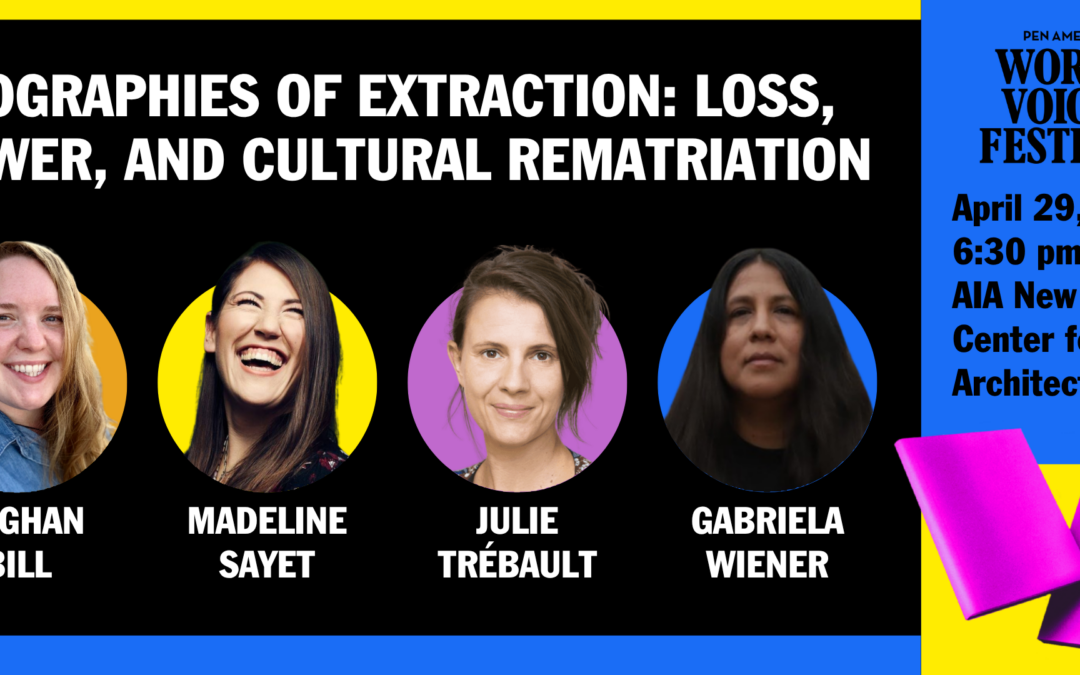
ARC @ PEN World Voices Festival 2026
New York, NY

Wednesday 29 April 2026
6:30PM & 7:45PM
AIA New York Center for Architecture
536 LaGuardia Pl.
Manhattan, NY 10012
Use ENJOYWVF26 for 50% discount
In a conversation moderated by ARC Executive Director, Julie Trébault, titled “Geographies of Extraction: Loss, Power, and Cultural Rematriation,” three writers ask: what do the journeys of human remains, cultural artifacts, and iconic artworks reveal about our history? What makes the violence and asymmetries that have shaped their extraction, preservation, and return both collective and deeply personal experiences?
It was on a tour of the British Museum years ago that Mohegan theater artist Madeline Sayet (Where We Belong) discovered a collection of Native American skulls—objects the museum classified as artifacts, but which she understood as ancestors, alive with the yearning to return home. In Gabriela Wiener’s irreverently witty novel, Undiscovered (tr. Julia Sanches), the Peruvian writer is confronted by her complicated family colonial heritage in a museum in Paris when she discovers the man responsible for pillaging these pre-Columbian artifacts was her own great-great-grandfather. Joining them is Meghan Bill, Coordinator of Provenance Research at the Brooklyn Museum, where she investigates the histories of works in the museum’s permanent collection and advises on issues of repatriation, restitution, and acquisitions due diligence.
Speakers
Madeline Sayet
Madeline Sayet is a Mohegan director, playwright, and scholar who believes the stories we pass down shape our collective possible futures. Her accolades include being named a MacDowell Fellow, Hermitage Fellow, TED Fellow, MIT Media Lab Director’s Fellow, Native American NCAIED 40 Under 40, Connecticut Magazine 40 Under 40, and a recipient of the White House Champion of Change Award from President Obama. She is a resident artist at Centre Theatre Group in Los Angeles and a member of Long Wharf Theatre’s artistic ensemble. As both a Shakespearean director and scholar, she serves as Clinical Associate Professor in the English Department at Arizona State University with the Arizona Center for Medieval and Renaissance Studies (ACMRS). She served six years as Executive Director of the Yale Indigenous Performing Arts Program (YIPAP), where she ran an annual new Native play festival and created programming to uplift the next generation of Native theatre artists.

Gabriela Wiener
Gabriela Wiener is one of the essential voices of contemporary Latin American literature in the diaspora. A Peruvian writer, poet, and chronicler based in Spain, she has turned the body into a political and narrative territory. Her work questions the fictions of power, patriarchy, colonialism, and the mandates of heteronormativity and whiteness as systems of thought.
Through a hybrid, de-generated, autofictional writing shaped by memory and resistance, she transforms intimate experience—desire, motherhood, family, migration—into a critical mirror of social structures. In her novel Huaco retrato, she rewrites her family genealogy to confront racism, and in Atusparia she explores the political memories of the past in search of new revolutionary possibilities.
Her first gonzo journalism stories appeared in the narrative journalism magazine Etiqueta Negra. She is also the author of the nonfiction books Sexografías, Nueve Lunas, Llamada perdida, and Dicen de mí, and the poetry collections Ejercicios para el endurecimiento del espíritu and Una pequeña fiesta llamada Eternidad. She received her country’s National Journalism Prize for a story about gender-based violence in the literary world.
Undiscovered, the English translation of her novel Huaco retrato, was a finalist for the 2024 International Booker Prize, the PEN America award, and the 2025 Rómulo Gallegos Prize. Her novel Atusparia won the Ciutat de Barcelona Prize for Best Book in Spanish.
Meghan Bill
Meghan Bill is the Coordinator of Provenance Research at the Brooklyn Museum. As the Museum’s primary provenance researcher, she investigates the histories of works in the museum’s permanent collection and strives to make that research more inclusive and transparent. She also advises the museum on issues of repatriation, restitution, and acquisitions due diligence. She has taught about provenance research and related legal and ethical concerns to museum professionals, legal professionals, not-for-profit boards, and students of all levels. She has an M.A. in Museum Anthropology from Columbia University and a J.D. from Fordham University School of Law.

Moderator
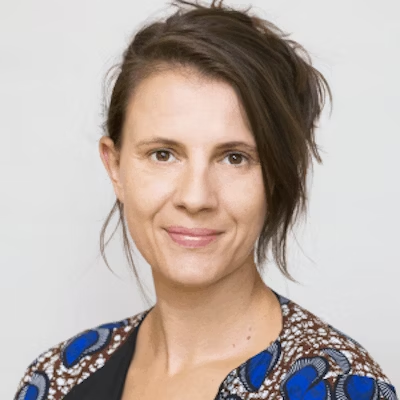
Julie Trébault
Julie Trébault is the Founder and Executive Director of ARC — Artists at Risk Connection, a global organization dedicated to safeguarding artistic freedom and supporting artists and cultural workers under threat. Under her leadership, ARC provides critical resources and support to more than 2,100 artists in more than 60 countries facing persecution from state and non-state actors, empowering them to overcome challenges to their creative expression. Prior to founding ARC, she served as director of public programs at the Museum of the City of New York and the Center for Architecture.