

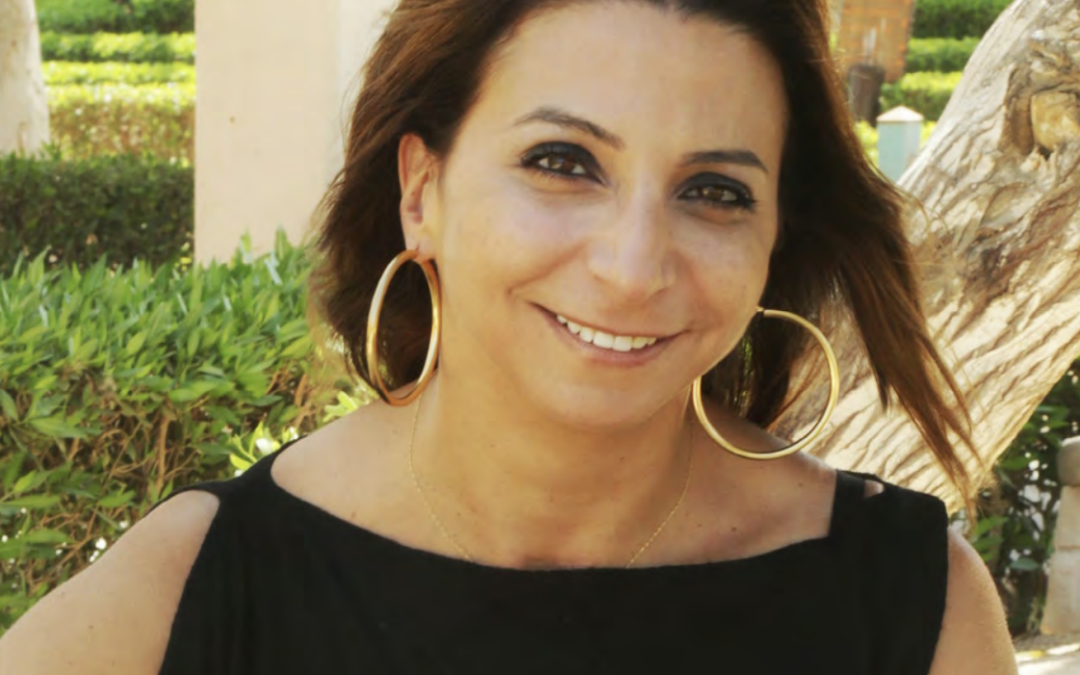
Zeina Daccache
Filmmaker
Lebanon
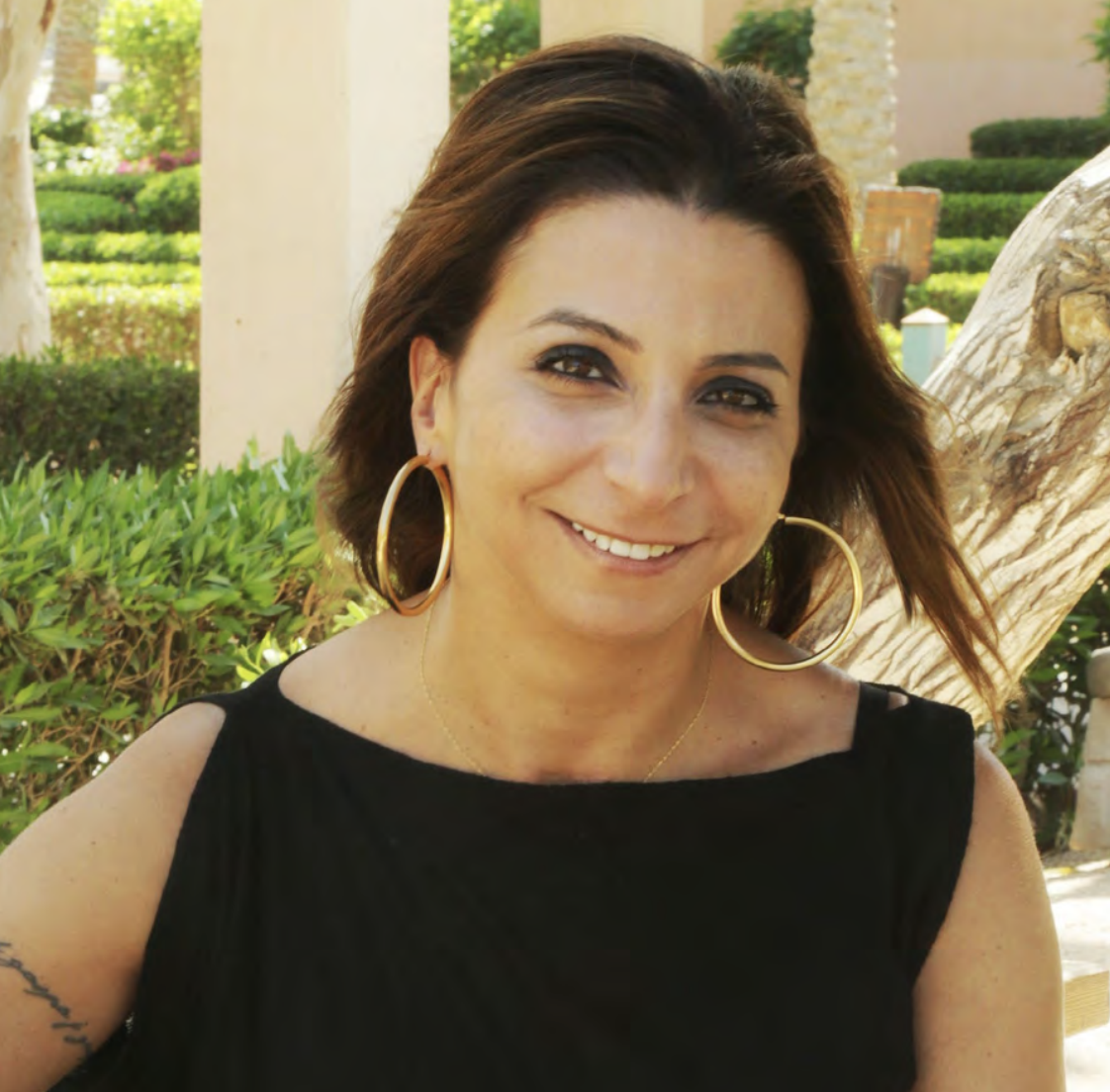
By Juliette Verlaque, June 2023. Originally published in Art Is Power: 20 Artists on How They Fight for Justice and Inspire Change.
In the last 15 years, Lebanese filmmaker and drama therapist Zeina Daccache has helped change numerous laws that shape the treatment of prisoners in Lebanon, from protecting victims of domestic violence to reducing sentences for good behavior.
These legislative victories spring from a multipronged and highly innovative process that begins with drama therapy: Daccache goes to prisons, provides therapy-guided sessions, and works with inmates to stage theatrical productions, which are open to the public. These productions are also filmed and subsequently screened in the outside world, often in tandem with a lobbying campaign focused on changing a particular law or addressing a need within the prison population.
Before discovering her calling as a drama therapist, Daccache was a successful actress and comedian in Lebanon for more than a decade. But the limitations of this work left her unsatisfied, and she found herself yearning for more. “I was always feeling that there was something more to art,” she says. “I cannot just be me in this classical theater and [people are] applauding me.… Where are the people? Where are the human beings? I was always unhappy. I was famous in my country, I did plays with the best theater directors in the country… but what’s in it for the whole society? Fun, that’s it … but what else?”
Daccache had always been fascinated by the workings of the human mind. Grappling with her lack of career fulfillment, she decided to pursue a degree in clinical psychology at Haigazian University in Beirut. While working toward this degree, she discovered the existence of a drama therapy program at Kansas State University and was instantly struck by the potential of this practice and the way it would allow her to combine her love of the arts with her interest in psychology. She immediately signed up for the program and traveled to the United States, completing the program in 2007.
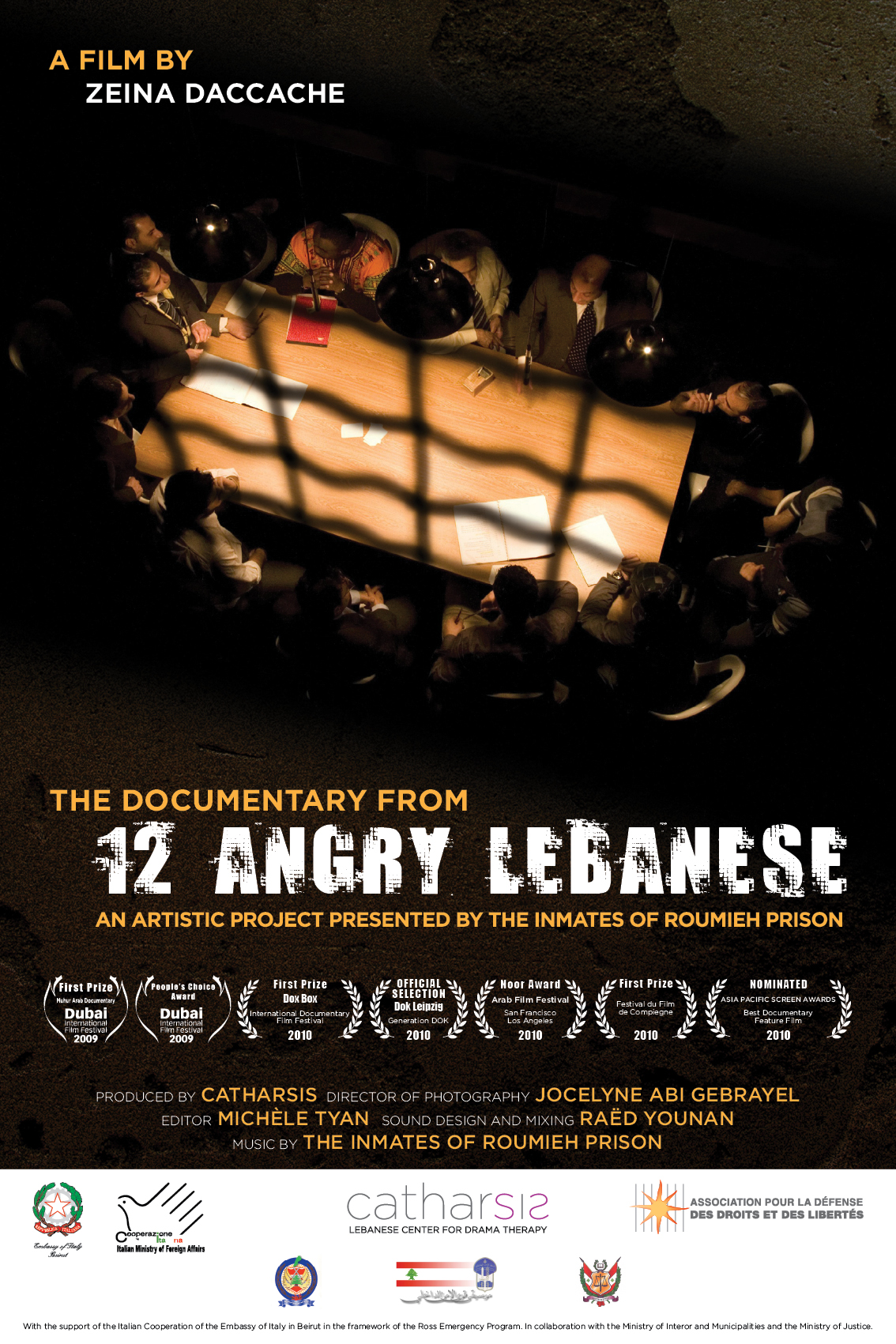
Poster for the 12 Angry Lebanese documentary, which premiered at the 2009 Dubai International Film Festival.
After receiving her degree, Daccache knew that she wanted to work in prisons. Back in 1999, she had done an internship at a prison in Italy, and working with the prisoners fascinated her. “[Prisons] are a microcosm of any society. They portray whatever is not working in your country, whether it’s drugs, corruption, poverty, or dictatorship.… They are the consequence of these issues. My motive for working there was that it represented an opportunity to work with the microcosm of my society, with real problems, and see where we can fix things.”
Upon returning to Lebanon in 2007, Daccache set up an NGO called Catharsis—Lebanese Center for Drama Therapy, knowing that operating as an official entity would ease her access to marginalized populations. She sought permits from the Lebanese government to practice in prisons—a lengthy process that required her to convince ministers that she did not have a political agenda. Her first job as a drama therapist was in Roumieh Prison in Beirut. Under her guidance, the inmates staged a production of 12 Angry Lebanese, based on the American movie and subsequent play 12 Angry Men. The making of this stage adaptation was filmed and turned into a documentary, 12 Angry Lebanese: The Documentary, which premiered at the 2009 Dubai International Film Festival and won first prize for Best Documentary and the People’s Choice Award. Soon after its release, Lebanon implemented a law that reduced sentences for good behavior, which remains in effect today.
Upon returning to Lebanon in 2007, Daccache set up an NGO called Catharsis—Lebanese Center for Drama Therapy, knowing that operating as an official entity would ease her access to marginalized populations. She sought permits from the Lebanese government to practice in prisons—a lengthy process that required her to convince ministers that she did not have a political agenda. Her first job as a drama therapist was in Roumieh Prison in Beirut. Under her guidance, the inmates staged a production of 12 Angry Lebanese, based on the American movie and subsequent play 12 Angry Men. The making of this stage adaptation was filmed and turned into a documentary, 12 Angry Lebanese: The Documentary, which premiered at the 2009 Dubai International Film Festival and won first prize for Best Documentary and the People’s Choice Award. Soon after its release, Lebanon implemented a law that reduced sentences for good behavior, which remains in effect today.
“[Prisons] are a microcosm of any society. They portray whatever is not working in your country, whether it’s drugs, corruption, poverty, or dictatorship.… My motive for working there was that it represented an opportunity to work with the microcosm of my society, with real problems, and see where we can fix things.”
Daccache anticipated that the filmed versions of the theatrical productions would help raise awareness of conditions in prisons, but their reach and effectiveness surprised her. “I never planned to have an impact on these inmates to become better people, for them to express themselves better, to make meaning, for them to come up with a nice product,” she says. “I knew that their product would bring much more awareness to society, an eye-opener for society to understand what’s inside our prisons and things. But it went much further than raising awareness. It became an advocacy for laws. We saw the laws changing.”
Daccache emphasizes that the lobbying process is an integral part of how this work has led to real legislative change. “You can’t just do your product and leave it out there for everyone to see,” she says. “You need to read the penal code in your country, understand what needs to be changed, go and meet the people who wrote your penal code, see why they wrote it that way.… You go to the parliament people, sit with them, have dinner, and talk with them. And you need to know who your allies are to make things happen, because if you don’t have allies, nothing will happen. It’s not like I’m going to just do art and things will change by themselves. I’ve done more than 2,000 meetings for every project when I wanted to make things happen.”
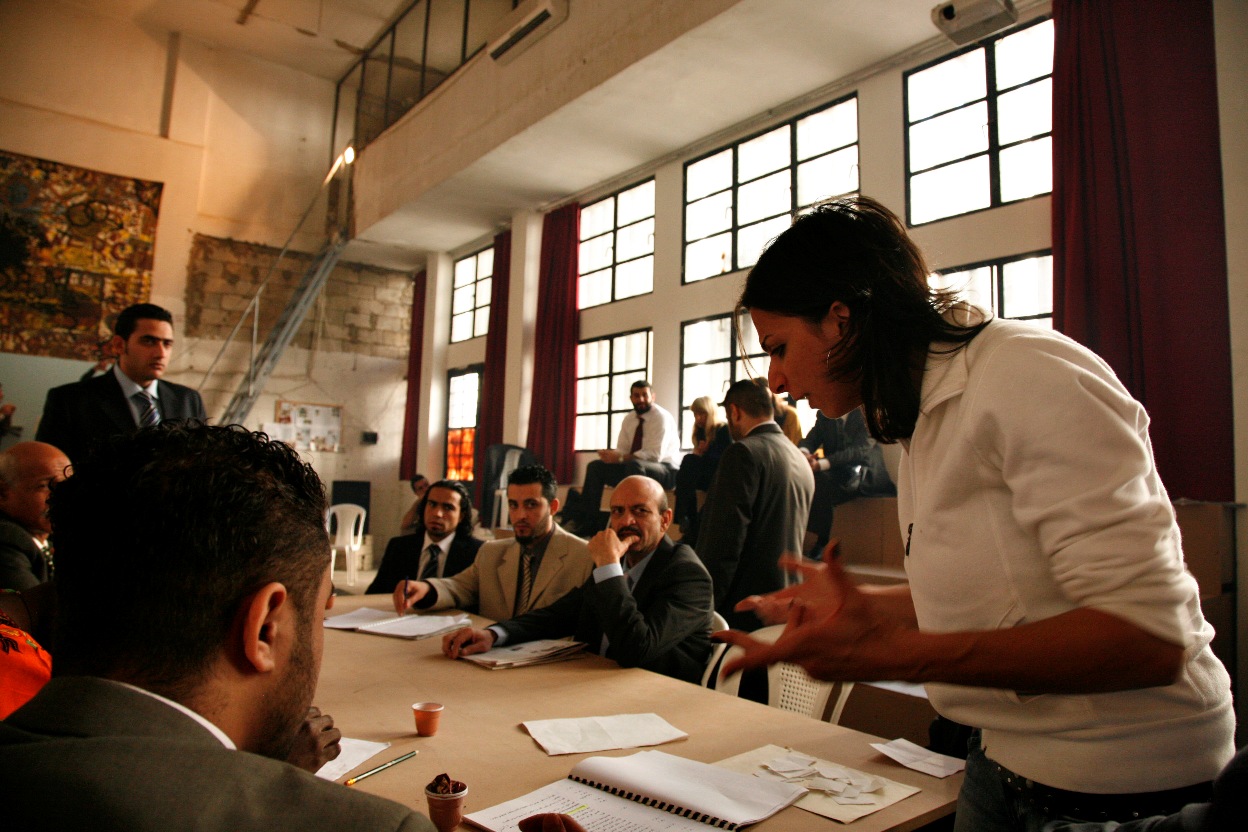
Daccache works with prisoners at Roumieh Prison during rehearsals for the 12 Angry Lebanese stage production in 2009. Photo credit: Dalia Khamissy/ Catharsis-LCDT
Over the last 15 years, Daccache has accumulated a remarkable track record of real legislative change—an all-too-rare outcome for any kind of artistic expression or activism, which only serves to underscore her deep passion for her work, her fiery, no-nonsense attitude, and her innovative and methodological approach. To evaluate the impact of her work, she focuses on three elements: First and most important, she says, is whether or not a law has changed as a result of the combined theater or film production and lobbying campaign. Next is audi – ence turnout and interest in viewing the theatrical productions and films. And third is the number of schools and universities that call Daccache to organize discussions with her or with ex-inmates, as well as the number of initiatives and NGOs that have emerged in Lebanon to provide support to prisoners since she began her work. She also pays attention to the psychological impact on the prisoners themselves: “How sleep changed, positive thoughts replacing the negative, hope for the future, relationships with family.”
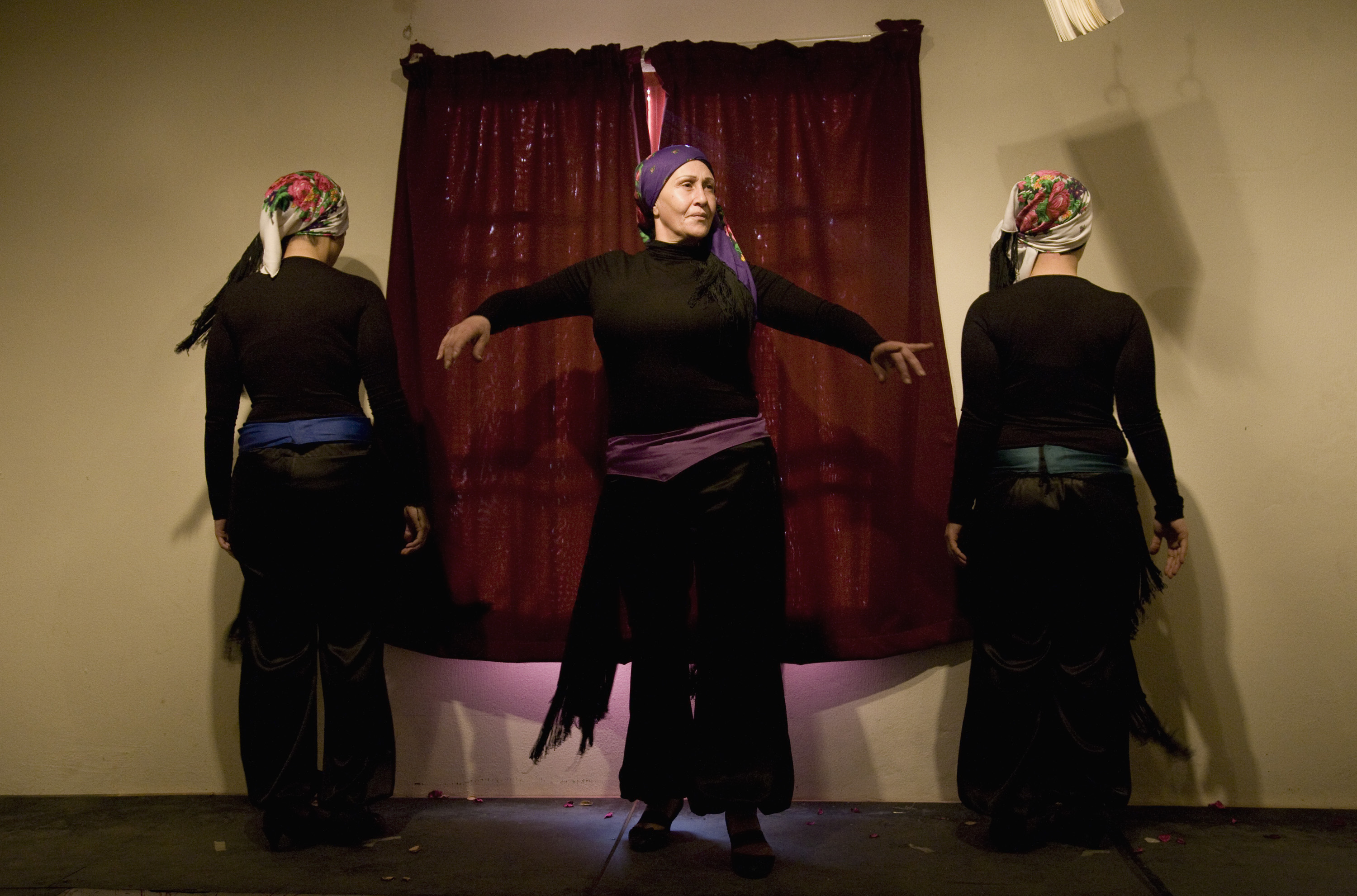
Rehearsals at Baabda Prison for the play Scheherazade's Diary in 2013.
Over the years, Daccache has worked with members of disadvantaged populations in Lebanese prisons, from women to people suffering from mental illnesses. She has also conducted a few projects with marginalized populations outside of prisons, such as migrant workers. Her goal is to help people advocate for themselves through the power of theater. “My belief is that I can’t claim people’s rights for them,” she says. Instead, “I go and give you the tools. The tool that I master is theater and therapy. So I walk you through the tool that I know—for you to convey your voice. But it’s you on stage conveying it, and it’s you in the film conveying it.”
“I didn’t plan to become an activist. But when I saw that the work I was doing, especially in prisons, was leading to legal reforms [and] I saw the implementation of laws that never existed before, thanks to the work I was doing in prisons, it seems I became an activist. The artistic products are tools to push for changing laws.”
Since 2019 Daccache, like many others in Lebanon, has struggled in the wake of a devastating financial crisis and political turmoil. While she has done her best to continue her work in prisons, including via Zoom group therapy sessions throughout the COVID-19 pandemic, Daccache says that the instability has severely challenged her ability to keep up this work and lobby the government. “Lebanon is in this total chaos,” she says. “There is no government. There are no decisions being made for the basics of your life—if you’re going to have electricity or not, If you’re going to have medicine or not, if your money is going to be back or not. It’s not the time to do any of these projects. If you don’t have a government, you can’t do the job.”