

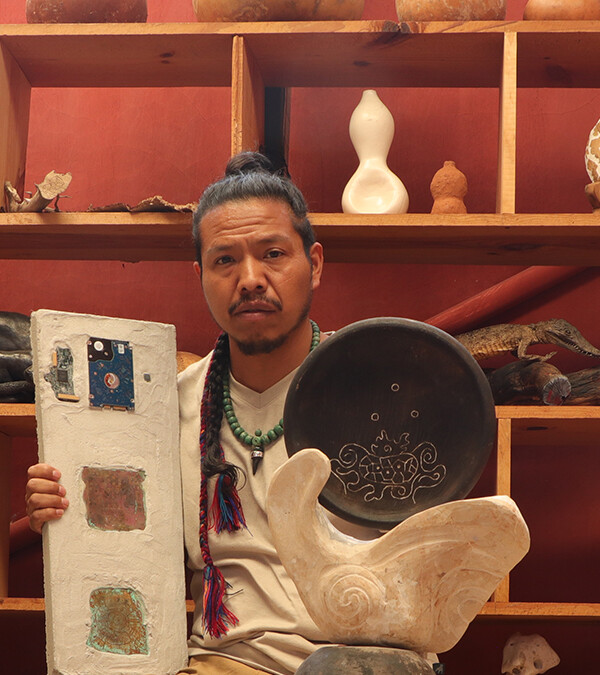
Gerardo K’ulej
Multidisciplinary
Mexico
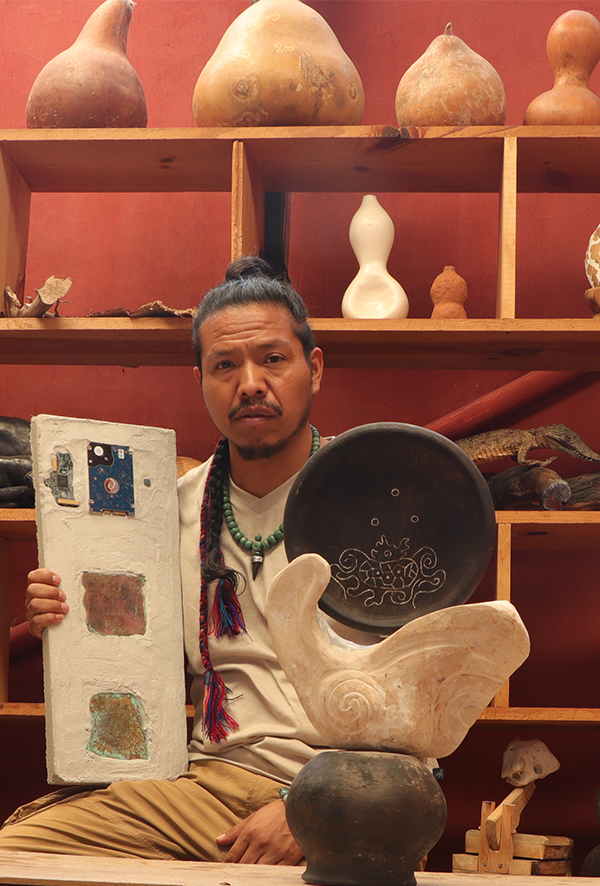
For Gerardo K’ulej, a Maya Tsotsil multidisciplinary artist, creating is a form of return.
K’ulej grew up in the village of Los Altos de Chiapas in southern Mexico, steeped in the knowledge and practices of his family. He remembers journeys from his home to the milpa–a field for growing crops based on a unique agricultural system used throughout Mesoamerica. He remembers the colors and shapes of the landscape, the games he invented based on what he found in his vicinity, the rituals and ceremonies of communal life. At the time, he didn’t think of any of this as art. It’s only now, when looking back, that he recognizes these experiences as some of the first forms of creativity he would know.
His path to art was not straightforward. He left his community to study biochemical engineering and afterwards completed a masters degree. In asking himself why he chose this path, he finds a possible answer in his interest in microorganisms, plants, the processes of the milpa, and the interactions between people and nature that he has known since childhood.
With time, he began to feel that his studies were taking him away from something.
“I was beginning to unlearn the practices and knowledge of my people and my ancestors,” he remembers.
After finishing his master’s he began to ask himself other questions. He wanted to better understand his own knowledge system as a Maya Tsotsil and those of other Mayan peoples, from their astronomy and mathematics, to their ways of relating to their environment. In order to do so, he needed to find a new way to dialogue with his community.
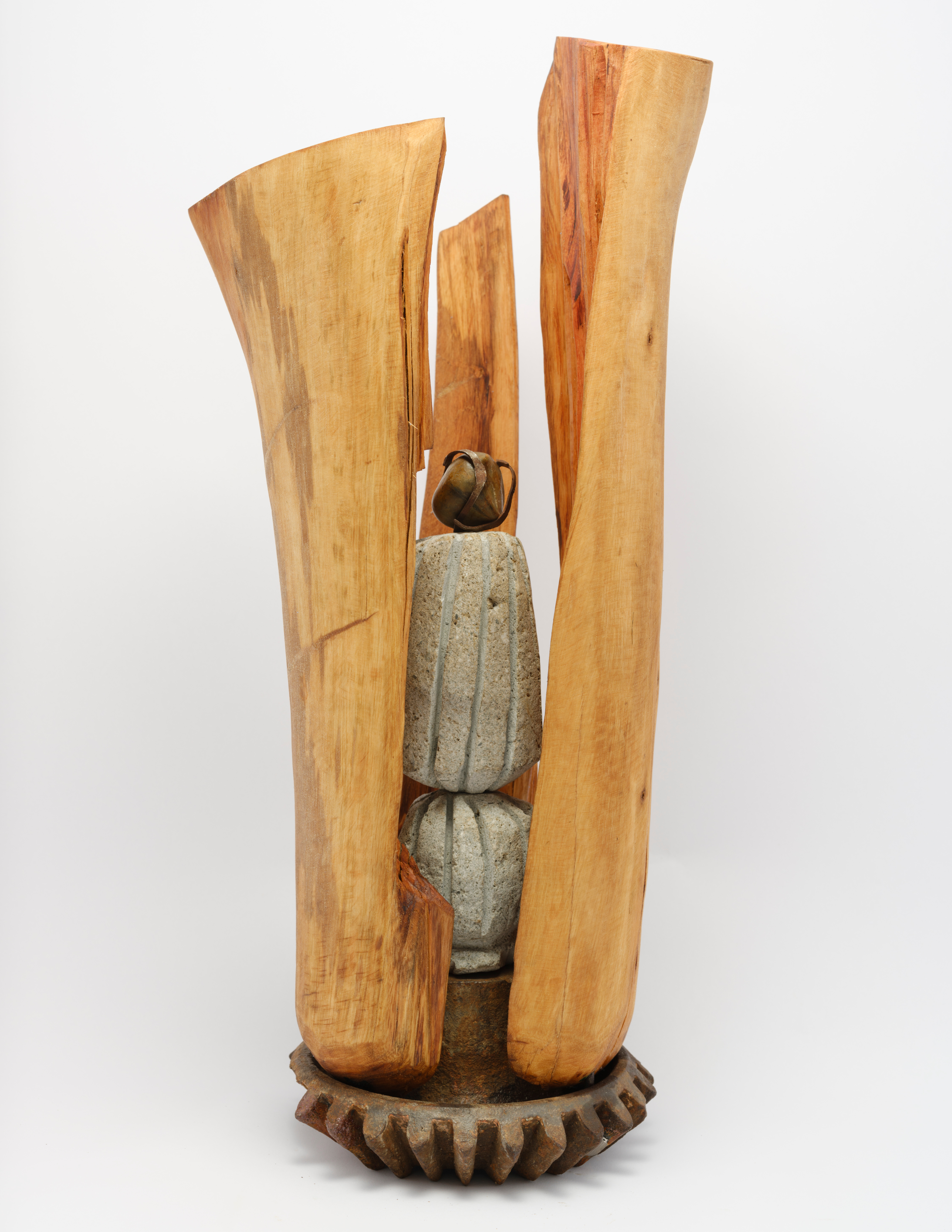
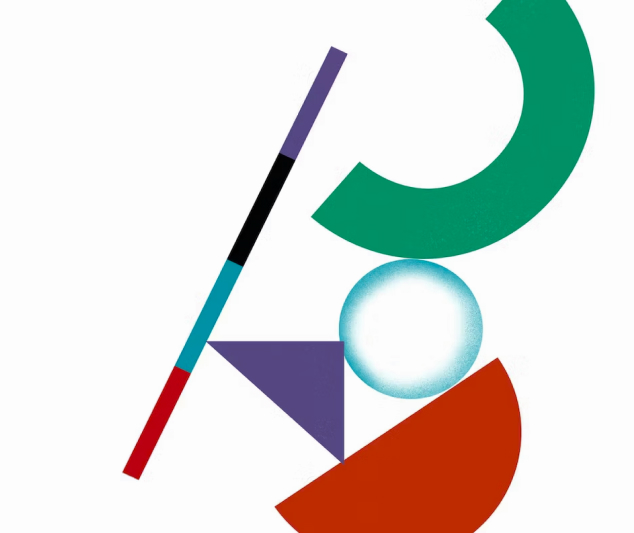
Untitled. Image courtesy of the artist.
This act of searching is also transmitted in the mediums with which he works. In his sculptures, he used stone, wood, and other found natural materials. His manner of approaching them is linked to ch’ulel, a word from his community that is related to the connection with nature and the elements. K’ulej speaks about ch’ulel as something closely linked to “consciousness,” “energy” and that which is felt but remains invisible.
His parents taught him, for example, that even a stone possesses ch’ulel.
“When you hold it, you must also hold it with a lot of respect. You do not simply treat it as an inert element, isolated from an interaction.”
This respect is an integral part of his way of working with stone, wood, and other objects.
But for K’ulej, returning to ancestral knowledge does not mean resurrecting a fully intact past; There is knowledge that is no longer within easy reach. When he visits sacred spaces or archeological sites, he encounters elements that he strives to understand, but does not fully know how to interpret. Other forms of knowledge persist through living ancestors and oral traditions.
It is this discontinuity that K’ulej finds an opening for contemporary art: “giving new meaning to our forms of knowledge.”
This dialogue may take the form of painting, sculpture, or photography, but also through formats such as video, performance, or installation. K’ulej understands them as tools to return to these forms of knowledge, and at the same time, reveal the tensions that cut through communities today. Art, he says, also allows for a critical reinterpretation of official accounts of history.
For him, it can serve as a “political, poetic action” which allows one to visibilize and denounce what is threatening Indigenous territories, languages, and communities.
This reflection also reaches the categories that exist within the art world itself. K’ulej asks himself from what vantage point an artist or an artwork is defined as Indigenous. He also problematizes an individualist way of understanding artistic practice, which he associates with western art in general. In the face of this, what interests him is creating from a perspective of community.
K’ulej forms part of a collective of artists in the state of Chiapas with whom he continuously contends with these questions. They do not always see eye to eye, they come from different communities, and their experiences are diverse. But the dialogue and the support that exists between them is a constant. Likewise, he finds affinities with artists from further afield, including in neighboring Guatemala.
“I think, well, I’m not alone at least,” he says. “We are together.”
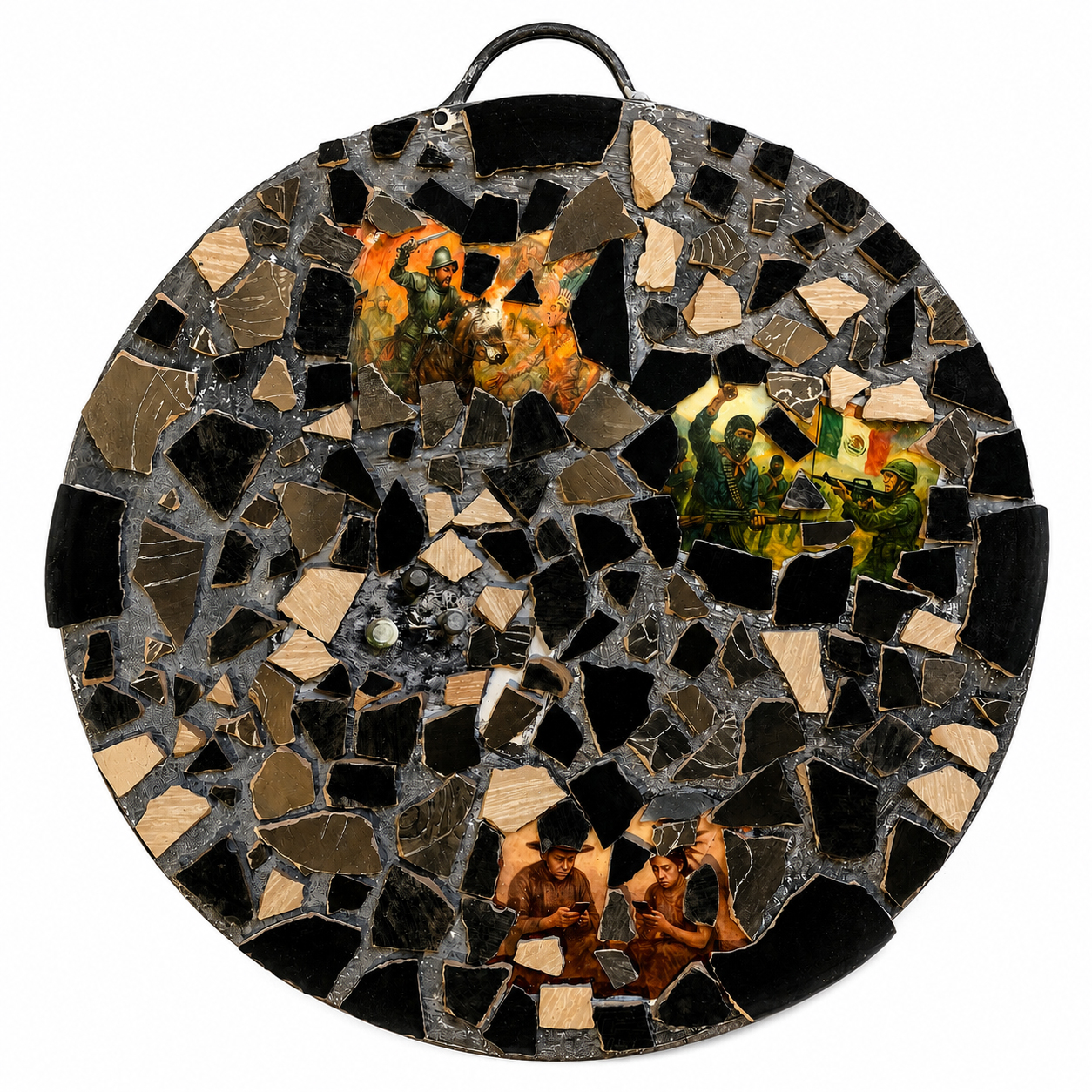
Big Bang Chiapas. Image courtesy of the artist.
This togetherness takes on a new importance when the subject of a work touches on themes that could generate backlash, or repression. To this end, Gerardo recognizes when some of his works surpass general “denouncement” and become a more direct criticism of the government. Before approaching certain topics, he considers how state actors or individual subjects of criticism might react. “One still does not feel completely free,” he says
Sometimes he decides that it still isn’t the right moment for work that delves into topics that still carry too much risk. And he does not only think about what could happen to him. He also thinks about his family.
“I try to engage critically in a way that remains slightly hidden. It is not so direct, but the message is there.”
K’ulej learned about ARC by way of other artists. Until then he knew little about the organization or others like it, and still recognizes the difficulty in encountering networks for support. But just knowing that this type of support exists is a relief to him, and affirms his feeling of not being alone.
In his most recent work, K’ulej is focused on another change that he has observed within the communities around him: the ever accelerating infiltration of technology into daily life.
To talk about this, K’ulej uses the example of the fogón. The fogón is the traditional space where a fire is made, and where a comal to cook tortillas is placed. In his childhood and youth, it was also a space for conversation. There, he listened to and talked with his elders.
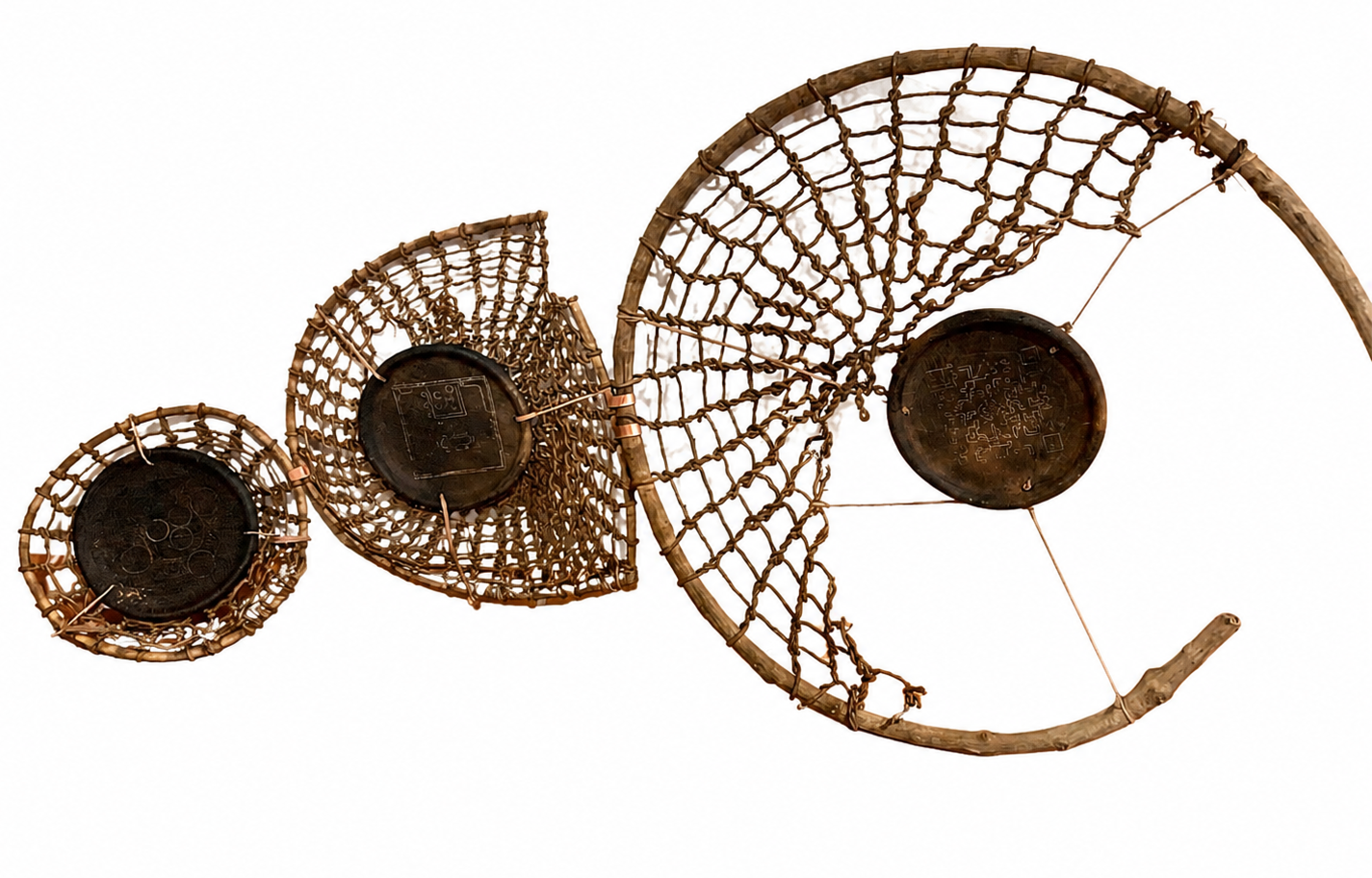
Comal 101. Image courtesy of the artist.
Then, there was television.
K’ulej remembers his attraction to it, and his growing distance from the fogón: moving from a shared space to a more individual one. Today he observes similar processes unfolding with cell phones and access to the internet.
But the relationship that he establishes to technology is not simply one of rejection. He is interested in considering what communities can do with it. For example, he’s seen people creating videos in the Tsotsil language, and filming their grandparents as they share their wisdom. At a time of rapid change, those very same tools may serve to protect knowledge that could otherwise disappear.
Artificial intelligence has also provoked other questions.
Experimenting with an AI tool, K’ulej asked for a representation of an Indigenous person using a mobile phone. The result were images of people in feathered headdresses. “But my mother doesn’t look like that,” he thought.
From this interaction, he began to wonder how these systems are fed, and from what hegemonies such images are produced. He also asked himself whether virtual realities could simply become other forms of colonization.
These questions persist in K’ulej’s work today. How does technology change community life? What does one lose when the fogón ceases to be a space for encounter? And how can the very same tools that represent a threat to traditional ways of life, also record a language, preserve the voice of a grandparent, or simply question the images of Indigenous peoples produced by outsiders.
Speaking about what allows him to continue creating, K’ulej returns to the thought of his fellow artists. He is motivated by viewing their work, by furthering dialogue, and by the knowledge that the pieces–once showcased–can provoke new questions and reflections.
And when he thinks about what he would want those who encounter his work to take with them, he returns to the same place.
“I would wish for them to take the community with them: The knowledge of the community, or the very language of the community itself.”
K’ulej insists that he does not claim to represent his community. Nor is what appears in his work merely his own: It derives from having transited, lived, and learned in the place that he did.
He hopes that those who approach his work think about a “collectivity of learning,” about that which has always been “communal, shared.”