
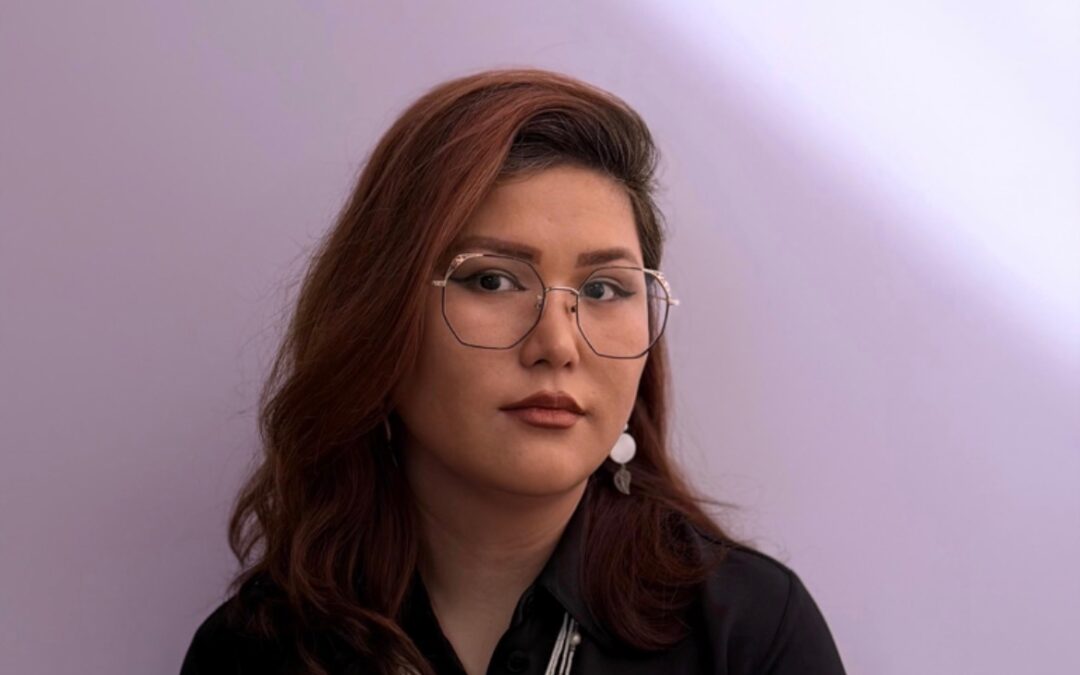
Zahra Abrahimi
Visual Artist
Afghanistan
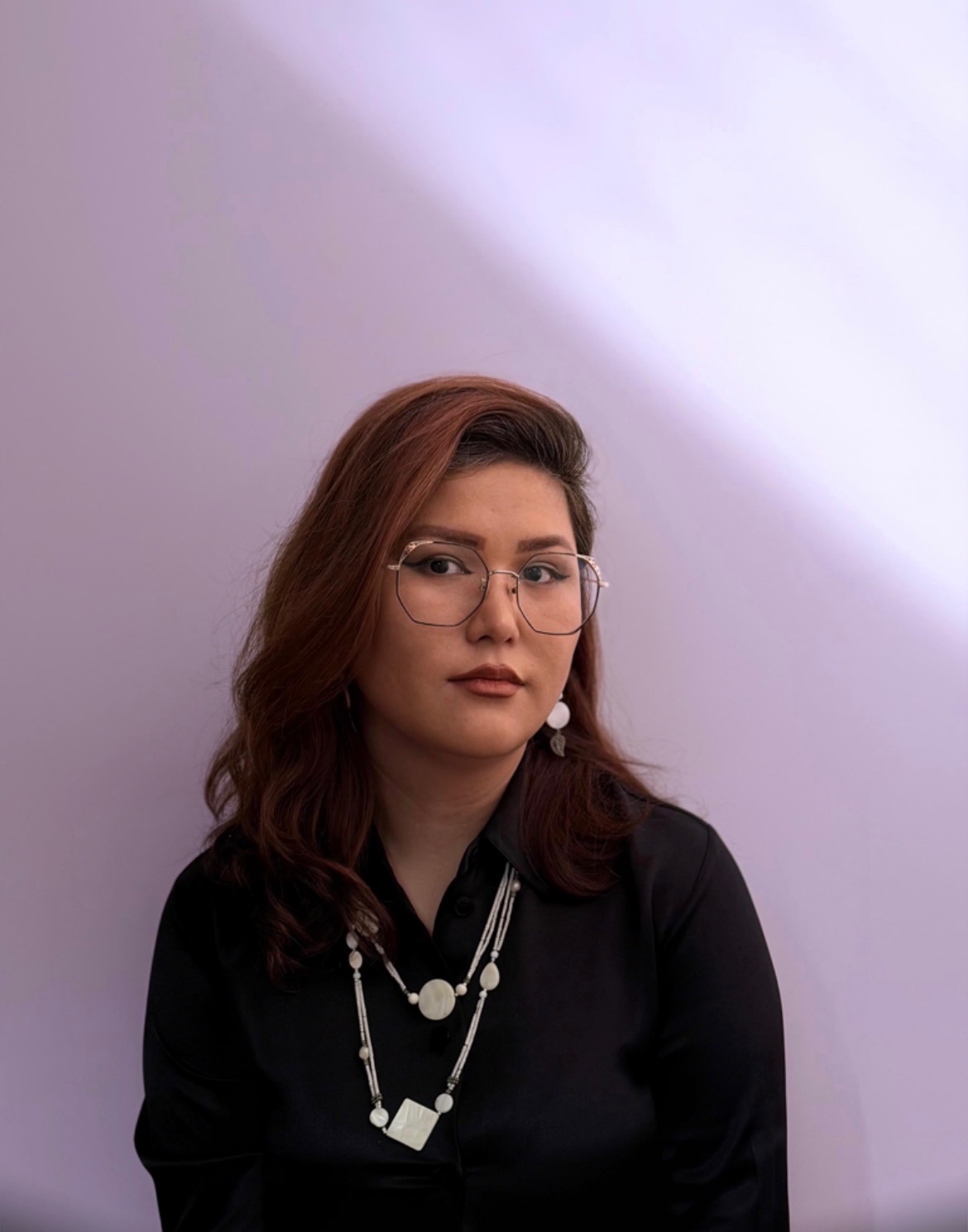
Zahra Abrahimi knows well that when you leave your country, a piece of it stays with you forever.
A painter and muralist from Mazar-e-Sharif in Afghanistan, Zahra is now living in Paris after 3 years in exile in Pakistan. In an interview with ARC, she recounts the events that led to her departure from Afghanistan, the repression that followed her, and the feeling of duty that continues to aliment her creativity,
“At that time, drawing was something completely new for us. I had no knowledge of painting, art history, or famous artists, art was only a school subject, and I was not even good at it.”
At 14 years old, art arrived unexpectedly to Zahra’s life when a small private center began offering drawing classes in the neighborhood where her family lived. At her sister’s encouragement, Zahra continued to attend classes, and began to find her footing in a practice that was still distant to her and her family. She remembers: “At that time, drawing was something completely new for us. I had no knowledge of painting, art history, or famous artists, art was only a school subject, and I was not even good at it.” She continued to attend classes for almost a year, stopping to focus more on school as her father wanted her to become a doctor.
After the end of her formal art classes, Zahra continued to draw at home, and her younger sister joined in with her. With time, her work shifted from a technical focus, to a thematic one, becoming an outlet for vocalizing what was difficult to say in conservative Afghan society: She created works which reflected the challenges faced by Afghan women. She called for gender equality, and spoke out against gender-based violence. “This time, my art became a form of advocacy,” says Zahra. “By then, I was no longer a child, but a conscious woman who understood the intensity of women’s oppression in Afghan society.”
Openly embracing this new sense of creative purpose, Zahra organized several exhibitions in Mazar-e-Sharif, displaying work that unflinchingly approached the issues that were closest to her heart. But Zahra’s advocacy work did not end there. After finishing university, she worked as a volunteer in women’s rights, peacebuilding, and other human rights initiatives. In her commitment to this work, both in her creative life and alongside it, Zahra courted controversy, and danger.
“This time, my art became a form of advocacy…By then, I was no longer a child, but a conscious woman who understood the intensity of women’s oppression in Afghan society.”
The decision in 2020 to leave her home city, Northern Afghanistan’s urban center, cultural heart, and capital of the historic Balkh region, came after Zahra began to receive threats for her work. After her arrival to the country’s capital, Kabul, the threats against Zahra’s life continued, as did the menacing phone calls she received. After eight months in Kabul, a feeling of danger infiltrated her daily life. She decided to go to Pakistan, where she reunited with NNVAC, a group of Afghan painters in exile. No one knew it at the time, but as they were piecing together a new life in Pakistan, the Afghan Republic was in its twilight days. In a lightning offensive, Afghan cities and provinces were falling to the Taliban. By 15 August 2021, Kabul fell, and by the first week of September, the Taliban’s control had solidified in every corner of the country.
As Taliban abuses came to light, NNVAC turned to their creative disciplines, seeking to find a collective voice amidst the turmoil. Together, they organized an exhibition titled Dark Cage in Pakistan’s political capital, Islamabad. One night before the opening, the exhibition was shut down by the Pakistani authorities due to pressure and threats linked directly to the neighboring Taliban. For Zahra, life in exile was full of fear and compounding challenges: The fact that the Taliban officials were able to preemptively censor her and her colleagues’ work, even from abroad, added to the sense that the repression they faced was transnational.
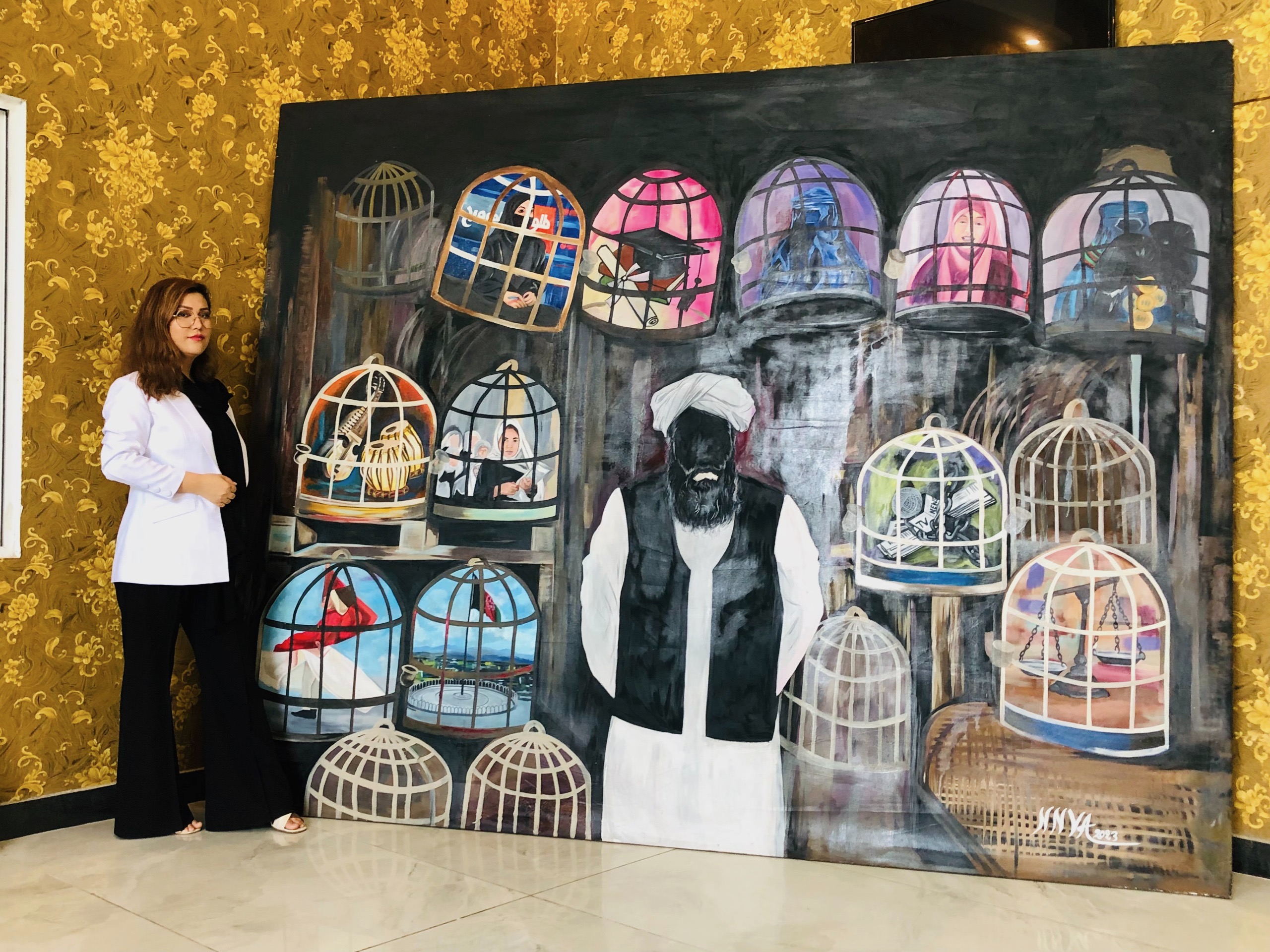
Zahra with one of her pieces from the "Dark Cage" exhibition
Even before she left Afghanistan, and before her country fell to the Taliban, Zahra had grown accustomed to mounting pressure. As conditions in Afghanistan worsened in the waning years of the republic, the political and social climate pushed her work toward themes of resistance, identity, loss, and survival. Art became a way to document suffering, preserve memory, and speak against injustice when she deemed direct speech too dangerous. But as threats against her mounted, Zahra’s way of working changed. Creating art became increasingly risky. The exhibitions she held in Mazar-e-Sharif were limited or forced underground, materials were difficult to access, and safety was always uncertain. In this climate, art itself became an act of resistance. Zahra adapted to working in secrecy, using veiled meaning and symbolism, and later, by continuing her practice in exile.
“Art became my only weapon. Through it, I resisted both cultural oppression and political violence. When the Taliban returned to power and I was forced into exile, my fear did not silence me, it strengthened my resolve. Art became a tool of resistance, protest, and preservation of identity, a way to remain visible when invisibility was being imposed.”
Today, Zahra has lived in France for only seven months, and restarting her life from scratch has been difficult. She does not yet speak French fluently, and she has even faced the prospect of homelessness since arriving in the country. Nonetheless, the sense that she is free from constraint makes the hardships she faces in France bearable. She is determined to use this freedom to its fullest extent, to speak loudly, and to reach international audiences.
“Leaving Afghanistan,” Zahra says, “was a rupture and a continuation at the same time. I did not only leave a country; I left part of my identity, my family, and everything I had built. I was broken by exile and loneliness, but I also discovered freedom.” From abroad, she reflects on this freedom, and how Afghanistan changed after her departure and when the Taliban returned to power: “I understood that if I went outside wearing red, no one would stop me on the street, insult me, or force me to wear black.”
“I hope international audiences understand the depth of systematic discrimination and restrictions imposed on Afghan women. At the same time, I fear they may see Afghan women only as victims: weak, miserable, or deserving of pity. Afghan women are strong, resilient, and resistant. Even under gender apartheid, they continue to fight for their existence and dignity.”